
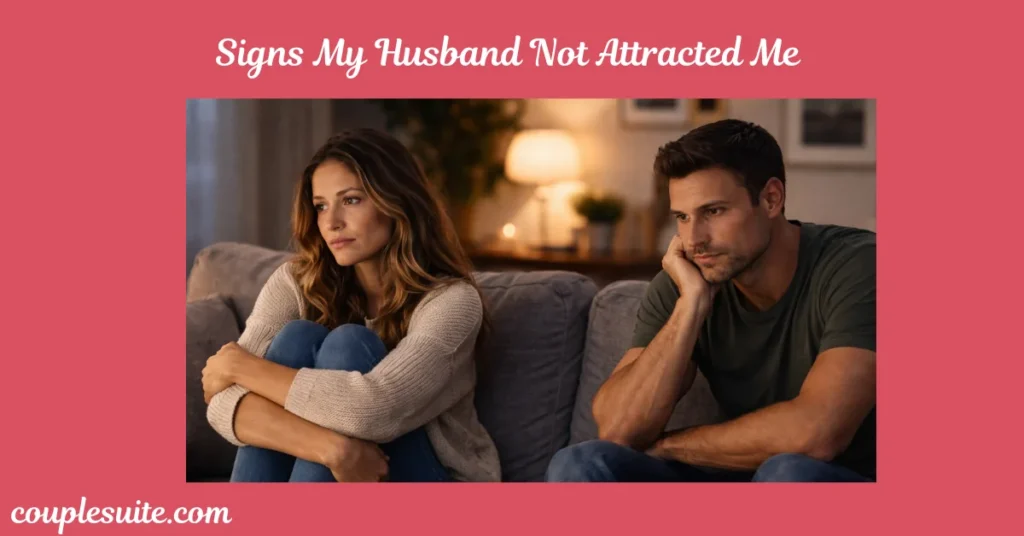
Is My Husband Still Attracted to Me? Reading the Real Signs
You have been asking yourself this question for a while now. Maybe for weeks, maybe longer. And the fact that you are asking it at all tells you something already. This article is for women who want an honest answer rather than reassurance.
Lost attraction in a long-term marriage is one of the most quietly painful things a woman can experience, partly because it is hard to name and partly because it develops slowly enough that you second-guess whether you are imagining it. This guide covers the physical signs that carry real weight, the emotional and behavioral shifts that are often more telling than anything physical, the signs that seem significant but frequently have innocent explanations, and what to actually do once you understand what you are looking at. If your concern is that things have grown cold in a specific way, understanding what a lack of intimacy does to a woman in a long-term marriage can also give your feelings context.
Physical Signs Worth Taking Seriously
Physical signs of lost attraction are the ones most women notice first because they are the most concrete. The difficulty is that many physical changes in long-term marriages reflect habituation, stress, or health factors rather than attraction loss. What you are looking for is a pattern of consistent change from his established baseline, not a single incident or a temporary period.
He has stopped initiating touch
This is one of the most consistent early signals. Early in a relationship, partners reach for each other without thinking: a hand on the back, a spontaneous hug, sitting close when there is no practical reason to. Over years, some of this naturalizes and becomes less frequent, which is normal. What is not normal is when it stops almost entirely, especially if he was previously someone who initiated physical contact regularly. The absence of non-sexual touch is often more revealing than changes in sexual frequency, because non-sexual touch is how attraction expresses itself outside the bedroom in daily life.
Your sex life has changed significantly
A change in frequency is expected in any long-term marriage and is well documented in research. What is worth paying attention to is not the frequency itself but the quality and character of what remains. If sex has become infrequent and also feels mechanical, brief, or devoid of the attention and engagement it once had, that pattern carries more weight than the number alone. Similarly, if he rarely or never initiates and also seems distracted or distant during intimate moments, the combination is meaningful. If he has begun declining consistently without explanation, that is a pattern worth examining.
He avoids or limits physical proximity
Beyond touch itself, pay attention to how he occupies space with you. Does he sit close when you are watching something together, or does he consistently choose the other end of the sofa? When you are in the same room, does he gravitate toward you or away from you? A person who is attracted to someone tends to be drawn into their physical orbit without consciously deciding to be. The reverse is also true. This sign is most meaningful when it represents a change from how he used to be, not just from an ideal.
Attraction in a long-term marriage does not stay the same as it was at the beginning, and this is not a failure. Research on how desire changes after marriage, tracked across hundreds of couples, shows that the brain chemistry driving early romantic attraction naturally transitions into an attachment-based form of love over time. What feels like fading attraction is often a shift in form rather than a disappearance. The distinction matters enormously when you are trying to understand what you are actually dealing with.
Emotional and Behavioral Signs That Are Often More Telling
Emotional withdrawal tends to be a more reliable indicator of genuine attraction loss than physical changes alone, and it is also the dimension most competitors on this topic skip entirely. Research tracking couples across the early years of marriage consistently finds that marital satisfaction and sexual satisfaction decline together and that emotional connection is the driver beneath both. These behavioral signs point to that deeper layer. If you are also wondering whether the relationship itself is in a more serious place of trouble, the signs a relationship may be ending for him covers a different and more definitive set of indicators.
He stops making eye contact during conversation
Eye contact in intimate relationships is a form of attunement. When a partner is emotionally invested, they look at you when you speak. They track the story. They respond to your face. When that changes, when conversations start to happen with his attention elsewhere, when he talks to you while looking at his phone or the television, when you finish a sentence and realize he has not really heard it, this is one of the quieter but more consistent signals that his emotional engagement has shifted. One conversation does not mean anything. A sustained pattern over weeks or months does.
He has stopped making deliberate effort
Effort is how attraction expresses itself in a relationship past the early stage. Booking something you would both enjoy without being asked. Remembering a detail from a conversation and following up on it. Choosing to spend an evening with you instead of defaulting to other activities. When a husband is attracted to his wife, he tends to create small opportunities to be with her and to show her that he has been thinking about her. When those behaviors diminish noticeably, not because life has become busier in a temporary way but as a sustained shift, it is worth paying attention to.
Conversations have become functional
In marriages where attraction and emotional investment are present, partners talk about more than the logistics of shared life. They ask questions that have nothing to do with childcare or finances. They share things that happened to them because they want to share them with this specific person. When conversations narrow to the operational, when you notice that you spend most of your time together talking about schedules, children, or tasks, and that there is rarely a conversation that goes somewhere personal or curious, this is a sign worth examining. It does not necessarily mean attraction is gone. It may mean emotional connection has eroded, which can reduce attraction as a downstream effect.
He shows less interest in how you look or what you are doing
This one is subtle but consistent. Partners who are attracted to each other notice each other. He comments when you try something new with your hair, not because he has to but because he is looking at you. He asks what you are working on or reading because he is interested in your inner life. When that quality of attention fades, when you notice that he does not see you the way he used to, it is one of the more honest signals that something has changed. Attraction at its root is attention. Its absence is also felt as inattention.
Signs That Often Have Other Explanations
Before drawing conclusions, it is worth naming the signs that get cited constantly in articles about lost attraction but that frequently have entirely different causes. Misreading these can lead to conversations that miss the actual problem entirely.
| What you are noticing | What it could also be |
|---|---|
| Less interest in sex | Chronic stress, depression, low testosterone, medication side effects, unresolved relationship conflict, or fatigue that has nothing to do with attraction to you |
| Seeming distracted or mentally absent | Work pressure, financial worry, health anxiety, a problem he has not raised with you yet, or a general period of high cognitive load |
| Less time at home or more time on his phone | A demanding period at work, a friendship he has been investing in, a new interest, or anxiety-driven avoidance of something in his personal life |
| Fewer compliments or romantic gestures | A personality baseline that was always lower than the early relationship peak, emotional exhaustion, or a period of low mood rather than lost attraction |
| Irritability or short temper | Stress, health issues, sleep deprivation, or unresolved grievances in the relationship that have nothing to do with physical attraction |
The pattern that most clearly points to attraction loss rather than these alternatives is a combination of physical withdrawal and emotional disengagement, appearing together, sustained over time, without an obvious external cause, and present even during periods when life stress is not unusually high.
What to Do If the Pattern Feels Real
Research on how desire changes across the course of a marriage makes clear that desire discrepancies between partners tend to increase over time, not decrease, and that the couples who navigate this well are the ones who address it directly rather than letting the distance compound. The first and most important step is a direct conversation.
Express what you have observed and how it has affected you, without framing it as an accusation or a question about his feelings for you. Something like: “I have noticed that we are much less physically close than we used to be, and I miss that. I want to understand what is happening between us” lands very differently than “Are you still attracted to me?” The first invites honesty. The second puts him on the defensive before the conversation has started.
If the conversation is difficult to have or goes nowhere productive, working with a couples therapist creates a structured environment where both of you can say what is true without it escalating. The Gottman Institute’s research on rekindling passion in marriage is worth reading before that conversation, both for framing and for understanding that what you are going through is far more common than it feels from inside it, and far more recoverable than it feels right now.
It is also worth examining what has changed on both sides. Attraction in a marriage is not one-directional. The quality of emotional connection between partners, how much effort both people are investing, how much novelty exists in the relationship, and how safe each person feels expressing desire all affect how attraction operates. This is not about assigning blame. It is about understanding the system rather than treating this as a verdict about your worth. Practical ideas for reintroducing novelty and closeness are covered in depth in the guide to spicing up intimacy in a long-term relationship.
If after an honest assessment the distance feels real and persistent, and if he is unwilling to engage with it directly or through professional support, that information is also meaningful. Not every marriage that reaches this point is recoverable, and understanding what you are actually dealing with is the only way to make a clear-headed decision about what comes next.
Frequently Asked Questions
There is no easy version of the question you have been carrying. But there is a difference between a marriage where attraction has genuinely faded and one where the connection has drifted and needs deliberate tending. Most of the women asking this question are dealing with the second. Understanding which one you are in is the only place to start.
If you want to understand what is happening in your relationship more clearly before having this conversation, the intimacy quiz and the is he the one quiz can give you a useful starting point for reflecting on what you actually need from this relationship right now.