
How to Plan a Couple’s Vacation Together
Planning a trip together sounds simple until you’re both staring at twelve open tabs, one of you wants the beach and the other wants a city full of museums, and neither of you has actually booked anything. Planning a couple’s vacation isn’t really about picking the perfect destination — it’s about making decisions together without one person quietly doing all the work.
 Good trip planning usually starts at the kitchen table, not the airport.
Every couple’s vacation carries its own small negotiation — how much to spend, how much to schedule, how much to leave to chance. There’s no single right way to plan a trip, but there are a few decisions worth making early, before you’re deep into browsing flights and forgetting what you actually wanted out of the trip in the first place.
Start With What You Both Actually Want
It’s tempting to jump straight to destinations, but that usually just leads to two separate wish lists that don’t overlap. A more useful starting point is talking through what kind of trip you each want, before either of you names a single place.
Once you’ve talked through these, the destination conversation gets a lot shorter, because you’re no longer debating a place — you’re just checking which options fit the trip you’ve already agreed you want.
Choosing a Destination You’ll Both Enjoy
Romantic getaways don’t have to mean an overwater bungalow or a European capital — they just need to genuinely suit both people traveling. A mountain town with hiking and quiet evenings might be more romantic to one couple than a beach resort ever could be to them, and that’s fine.
Beach vacations
Slow mornings, warm water, very little that has to happen on a schedule. Suits couples who want the trip itself to be the rest.
City breaks
Museums, restaurants, walkable neighborhoods, something new around every corner. Suits couples who’d rather come home tired from doing too much than tired from doing nothing.
Mountain getaways sit somewhere in between — active during the day, quiet by evening, with scenery that does a lot of the romantic heavy lifting without either of you trying too hard. If you’re torn between two genuinely appealing options, CoupleSuite’s Couple’s Decision Helper can settle it without either partner just giving in to keep things easy.
Setting a Realistic Travel Budget
Money is where a lot of couple’s vacation planning quietly breaks down — not because the numbers don’t work, but because they were never actually discussed out loud. A short, honest budget conversation early on avoids a much less pleasant one mid-trip.
- Agree on a total number before looking at flights or hotels, not after
- Decide together where you’re willing to spend more — food, accommodation, activities — and where you’re happy to save
- Build in a small buffer for the inevitable unplanned splurge
- Track spending as you go rather than tallying it up in shock afterward
Whether it’s a full honeymoon or a long weekend, CoupleSuite’s Honeymoon Planner handles multi-currency budgets and checklists in one place, and it works just as well for any couple’s trip, not only honeymoons specifically. If you’d rather keep budgeting separate from the itinerary, the Couple Expense Tracker is a simpler option for just watching what you’re spending as the trip comes together.
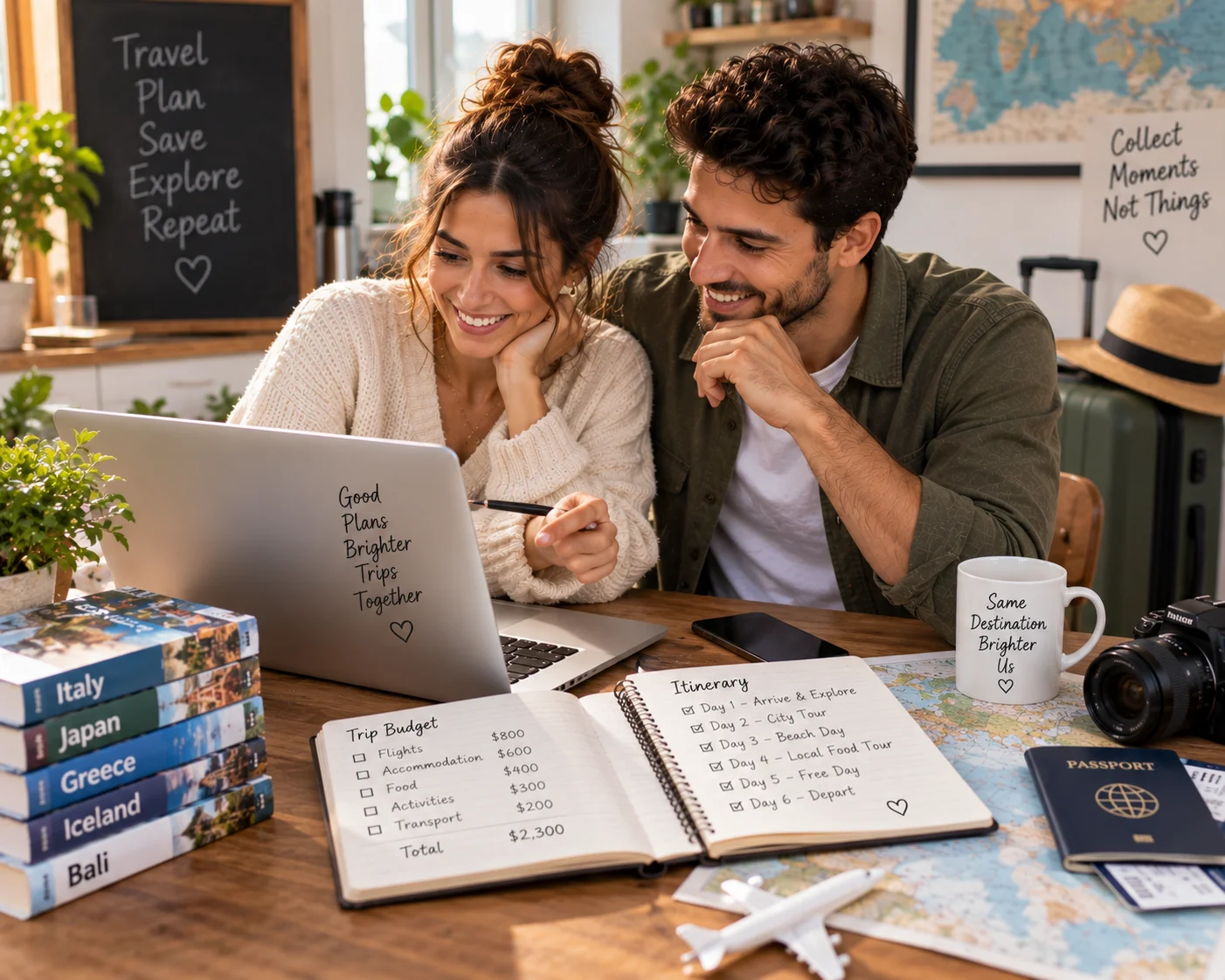 A short budget conversation before booking saves a much longer one mid-trip.
Building an Itinerary Without Over-Planning It
A travel itinerary should give a trip shape, not turn it into a checklist you’re racing to complete. The couples who enjoy their trips most tend to plan the big pieces — flights, accommodation, one or two must-do experiences per day — and leave the rest open.
Anchor each day around one thing
Pick a single highlight per day — a specific viewpoint, a restaurant you’ve been wanting to try, a local market — and build loosely around it. It keeps the day from feeling wasted without demanding a packed schedule.
Leave room for nothing
At least one stretch of unplanned time each day, even just an hour, tends to produce the moments couples remember most — an unplanned café, a wrong turn that led somewhere good.
Split planning duties
One person researches restaurants, the other handles logistics and bookings. Splitting the work prevents one partner from quietly becoming the trip’s unpaid project manager.
An itinerary is a guide, not a contract. Some of the best travel memories come from the plan you abandoned, not the one you followed perfectly.
Deciding on Trip Length and Timing
How long a couple’s vacation should be depends less on the destination and more on how much time you both actually have to properly switch off. A rushed week can feel more draining than a relaxed long weekend.
Timing matters too — a destination in peak season often means higher prices and bigger crowds, while shoulder-season travel can offer a quieter, more relaxed version of the same trip for less money.
Road Trips and Multi-Stop Travel
Road trips deserve their own mention, since they plan a little differently than a single-destination vacation. Instead of one itinerary, you’re building a loose sequence of stops with flexibility built in between them.
- Pick a rough route with two or three “must-see” stops, not a rigid stop-by-stop schedule
- Decide in advance how you’ll split driving, so it doesn’t default to one person the whole way
- Leave slack in the schedule for detours — some of the best stops on a road trip are the ones you didn’t plan for
- Book accommodation loosely ahead of time in popular areas, but stay flexible in quieter stretches
 Road trips reward a loose plan more than almost any other kind of couple’s vacation.
Packing and Travel Essentials as a Couple
Packing rarely causes real conflict, but a few small agreements ahead of time prevent minor friction at the airport or in a cramped hotel room.
- Decide who’s carrying what — documents, chargers, first-aid basics — so nothing gets assumed and forgotten
- Pack one shared “just in case” bag for snacks, medication, and small essentials
- Agree on how much luggage you’re both comfortable managing, especially for multi-stop trips
- Bring something for downtime — a book, a deck of cards, anything for the inevitable slow afternoon
Making the Trip Memorable, Not Just Photographed
Couple travel photos are worth taking, but a trip built purely around getting the shot tends to feel more like work than a getaway. A few ways to keep the memory-making genuine rather than performative:
The trips couples talk about years later are rarely the ones that went exactly to plan. They’re the ones with one good, slightly chaotic story attached — a missed train, a restaurant that turned out to be the best meal of the trip, a view you found by accident.
Couples tend to remember the unplanned parts of a trip more vividly than the parts that went exactly as scheduled.
A pattern often noted in travel and memory research
Planning a couple’s vacation works best as a shared decision from the very start — what kind of trip, what budget, how much structure — rather than one person planning and the other simply showing up.
Turning the Plan Into an Actual Trip
The gap between “we should travel more” and an actual trip on the calendar usually comes down to a few decisions nobody’s made yet — where, when, and how much. Have that conversation this week, even loosely, and let the rest fill in from there. A couple’s vacation doesn’t need a perfect plan to be a good one. It just needs both of you actually involved in making it.