
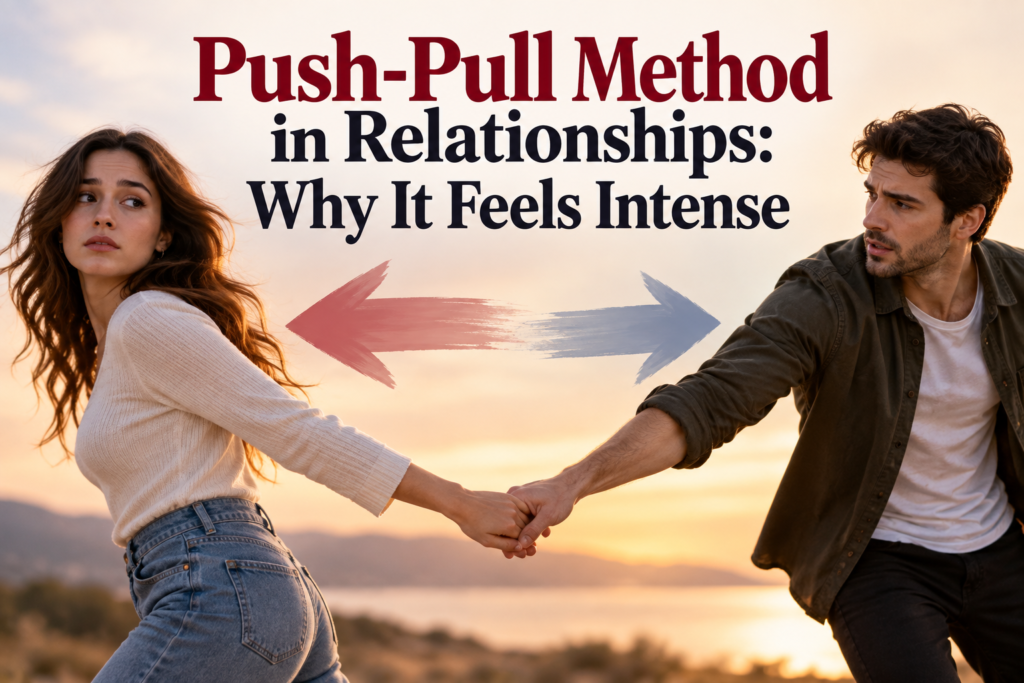
Push Me, Pull Me: What the Push-Pull Method Actually Does to a Relationship
There’s a particular kind of relationship that keeps people up at night — not because it’s terrible, but because it’s confusing. One week everything feels intense and close, the next your partner seems distant for no clear reason, and just when you’re ready to give up, they pull you right back in. This pattern has a name: the push-pull method. It’s worth understanding, because it shows up far more often than people realize, and not always by accident.
What Is the Push-Pull Method?
The push-pull method describes a pattern where one person alternates between pulling a partner in — attention, affection, warmth — and pushing them away — coldness, distance, mixed signals. It’s most often discussed in the context of early dating and attraction, where it’s sometimes used deliberately to generate interest, but the same pattern also shows up organically inside long-term relationships, usually without either person naming it as anything.
The core idea, borrowed loosely from psychology, is that inconsistency creates a stronger emotional pull than consistency does. Constant closeness feels safe but predictable. Constant distance feels safe to walk away from. It’s the alternation between the two — the uncertainty of not quite knowing where you stand — that tends to keep a person emotionally hooked, for better or worse.
Push-pull isn’t a single technique so much as a description of a pattern. It can show up as a deliberate dating strategy, an unconscious habit, or a symptom of two people with mismatched attachment needs.
Why the Push-Pull Pattern Feels So Addictive
There’s a real psychological explanation behind why push-pull dynamics can feel so gripping, even when they’re uncomfortable. Behavioral psychology has a term for it: intermittent reinforcement — a reward that arrives unpredictably is more compelling, and harder to walk away from, than one that arrives every time. It’s the same mechanism behind slot machines. A partner who is warm every single day becomes an expected, comfortable presence. A partner who is warm sometimes and distant other times keeps the nervous system slightly on edge, waiting for the next moment of closeness.
That’s part of why push-pull relationships can feel more intense, even thrilling, in the moment — and part of why they’re so often mistaken for chemistry, when what’s actually happening is a stress response dressed up as attraction.
The Playful Version vs. the Harmful Version
Not every version of push and pull is cause for concern. A light, mutual version of this dynamic — some teasing, some independence, some anticipation — is a normal part of flirtation and even long-term relationships. The difference comes down to intent, consistency, and whether both people feel secure enough to trust what’s happening.
Playful push-pull
Light teasing, maintaining some independence, a bit of mystery in early dating. Both people feel generally secure, and the “pull” always follows reasonably soon after the “push.” No real anxiety involved.
Manipulative push-pull
Withholding affection to provoke anxiety, deliberately creating uncertainty about the relationship’s status, or using distance as leverage. One partner ends up chasing reassurance the other keeps just out of reach.
The line between the two isn’t always obvious from the inside, especially early on. A helpful gut check: does the uncertainty ever fully resolve, or does it just repeat? A healthy dynamic settles into security over time. An unhealthy one keeps resetting the clock.
What’s Usually Driving the Pattern
Push-pull dynamics rarely appear out of nowhere. Most often, they trace back to attachment patterns — the underlying, largely unconscious blueprint each person carries for how closeness and distance in relationships are supposed to work.
Understanding which of these is actually happening matters, because the response is different in each case. A securely attached couple navigating one partner’s occasional need for space looks very different from one partner deliberately engineering uncertainty to keep the other hooked.
Signs the Dynamic Has Tipped Into Something Unhealthy
A few patterns are worth paying closer attention to, especially if they’re recurring rather than occasional.
- You find yourself constantly trying to earn back affection that seemed to disappear without explanation
- Reassurance, once given, doesn’t actually reduce your anxiety for long
- The relationship feels most “alive” during the reconciliation after a period of distance, rather than during ordinary day-to-day connection
- Bringing up the pattern directly gets deflected, minimized, or turned back around on you
- You’ve started anticipating withdrawal even during genuinely good moments
None of these signs alone is definitive, but a cluster of them, repeated over time, is worth taking seriously — both for what it says about the relationship and about your own sense of security within it.
Breaking the Cycle Together
If both partners recognize the pattern and want something more stable, the fix usually isn’t dramatic — it’s consistency, built slowly and on purpose.
- Name the pattern directly, without blame, as something you’ve both noticed happening
- Agree on a way to signal when one partner needs space, rather than defaulting to silent withdrawal
- Practice giving reassurance before it’s demanded, not just after a period of anxiety builds up
- Notice and appreciate the steady, unremarkable moments — not just the intense highs and the making-up afterward
Understanding your own and your partner’s underlying attachment patterns tends to make this conversation far more productive than trying to fix the surface-level behavior alone. CoupleSuite’s Attachment Style Quiz for Couples is built for exactly this — it compares both partners’ results and shows specifically how an anxious and avoidant pairing, for example, tends to interact, which is often the real engine behind a push-pull dynamic neither partner fully understands.
Relationships that thrive on uncertainty rarely feel calm from the inside — they feel intense, which is often mistaken for meaningful, when it’s really just unresolved anxiety on repeat.
A pattern commonly described in attachment-based relationship research
Building Real Attraction Without Relying on Uncertainty
It’s worth saying plainly: lasting attraction doesn’t actually require push-pull tension to survive. Novelty, shared growth, genuine curiosity about your partner, and consistent emotional safety are the ingredients that keep long-term relationships interesting — and unlike manufactured uncertainty, they don’t come with an anxiety cost attached.
Couples who want to keep checking in on how the relationship actually feels, rather than guessing based on the last dramatic high or low, can benefit from a more structured look at where things stand. CoupleSuite’s Relationship Assessment Scale Tool offers a private, research-based way to see the relationship’s patterns more clearly, without relying on how the last few days happened to feel.
The push-pull method can create real intensity, but intensity built on uncertainty usually isn’t the same thing as genuine connection. A relationship that has to keep resetting the tension to feel exciting is worth examining honestly, together.
Recognizing the Pattern Is the First Step
Most people who’ve experienced a push-pull dynamic don’t recognize it while they’re inside it — it just feels like an unusually intense connection, or a partner who’s simply hard to read. Naming the pattern doesn’t mean assuming the worst about a relationship; it means being honest about how closeness and distance are actually functioning between you. From there, the choice is a fairly simple one: keep chasing the next moment of reassurance, or build something steadier that doesn’t need the chase to feel real.